
Time travel has always seemed far-fetched and unrealistic, belonging to the world of sci-fi books and Hollywood blockbusters, like Back to the Future and Interstellar. While real time travel might not be as spectacular or fantastical as these portrayals, physics suggests that it might not be entirely out of reach.
We’re all time travellers, in some sense, constantly hurtling forward through time at a rate of one second per second. But could we ever travel faster, or even backwards, through time?
Could time travel ever become a reality?
Einstein and the Birth of Space-Time
Centuries before Einstein was even born, in 1676, Danish astronomer Ole Christenesen Roemer made the discovery that light travels at a finite, through very high, speed. He observed that the eclipses of Jupiter’s moons occurred later when Earth was farther from Jupiter and reasoned that light simply took longer to reach us.
In 1865, James Clerk Maxwell unified electricity and magnetism into a single theory, electromagnetism. Part of this new theory was the prediction that electromagnetic waves, including light, should always travel at a certain fixed speed.
This posed a problem: relative to what?
Under Newtonian mechanics, all motion is relative, so all speeds have to measured relative to something else. Scientists proposed an invisible substance called the “ether” that took up all of space, through which light waves supposedly travelled. If true, observers moving relative to the ether would measure different speeds of light.
In 1887, Albert Michelson and Edward Morley tested this idea. They compared the speed of light in the direction of the earth’s motion with that at right angles to it, but they found no difference. The speed of light was the same in all directions. There was no ether.
Then came Einstein.
In 1905, his Special Theory of Relativity explained the findings of the Michelson-Morley experiment elegantly. The speed of light could remain constant for all observers if we changed the way we saw time: time itself can change. From this idea emerged the famous equation E = mc², and the conclusion that nothing can travel faster than light.
A decade later, Einstein expanded his ideas into General Relativity, which redefined gravity not as a force, but rather the curvature of space-time caused by the distribution of mass-energy. As physicist John Wheeler summarised:
“Spacetime tells matter how to move; matter tells spacetime how to curve.”
This curvature also affects time. The closer you are to a massive body, the slower time passes. Near a black hole, a few hours for you could correspond to thousands of years for someone on Earth.
In other words, time is relative. It flows differently depending on where you are and how fast you’re moving.
Does this mean time travel is possible? In some ways, yes. The laws of physics suggest that time can be warped and manipulated. But to truly travel through time, we need to dig deeper.
Wormhole Travel
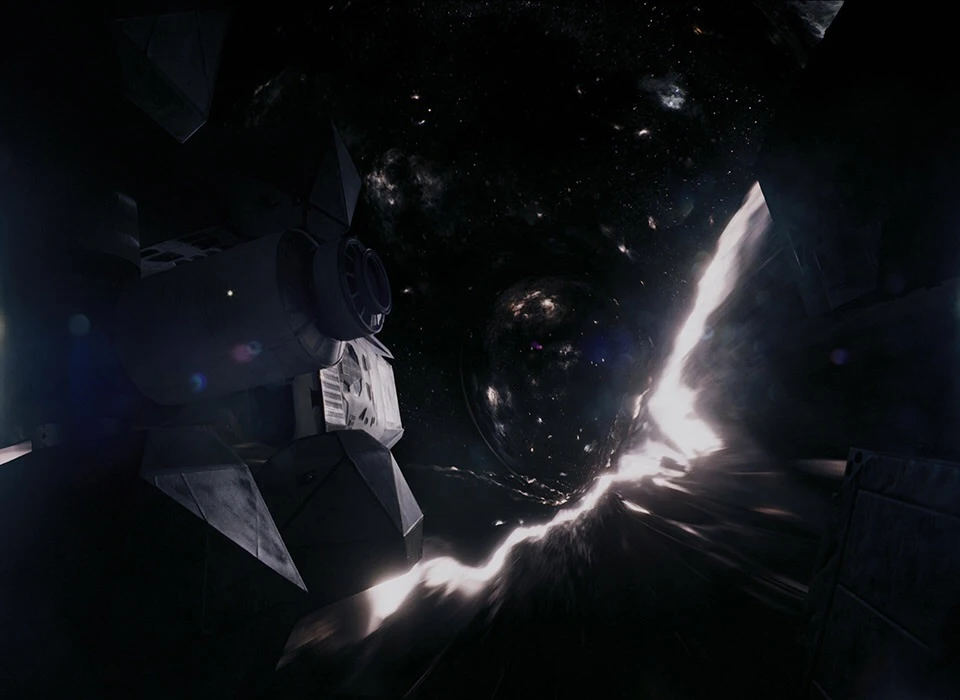
Einstein’s equations allow for the existence of wormholes, which are theoretical tunnels connecting two distant points in space-time.
Imagine space-time as a flat sheet of paper. To travel from one corner to the opposite corner, you could go across the surface, but this would take a long time. A faster route would be to fold the paper so the two points touch and poke a hole between them. That hole is the wormhole: a 3D shortcut through 4D space-time.
In 1983, physicist Kip Thorne began to explore wormholes as a means not just to travel through different points in space, but also between different points in time.
In relativity, space and time are intertwined. Connecting two points in space also connects two moments in time.
Now suppose you have two mouths of a wormhole, Mouth A and Mouth B. Keep Mouth A stationary, but move Mouth B near the speed of light for a while, or place it near a massive object. When it returns, less time will have passed for Mouth B compared to Mouth A, due to relativity. The two mouths remain connected, but are now out of sync in time.
That means if you enter the wormhole through Mouth B and come out of Mouth A, you could emerge before you entered. You could travel back in time.
However, there are several significant problems:
- We’ve never actually observed a wormhole.
- Keeping one open wouold likely require “exotic matter”, i.e. matter with negative energy density. Otherwise, gravity could cause the wormhole to collapse. While negative energy exists on extremely small scales, this is nowhere close to what is needed for a stable wormhole.
- Even if such a wormhole existed, quantum effects might destroy it the instant it became a time machine.
Infinite Cylinder Theory
Another possibility for time travel is the Tipler Cylinder, proposed by the astronomer Frank Tipler in 1974.
A closed timelike curve is a path through spacetime that loops back on itself. This means that an observer could, in theory, follow it and end up in the same place and time they started. This means the traveller would experience aging, but end up back before they embarked on the journey.
Tipler suggested that if you compress matter ten times the mass of the Sun into a long, dense cylinder, and then spin it billions of times per minute, it might create such a curve. A spacecraft following a precise trajectory around it could travel backwards in time.
Unfortunately, the model only works if the cylinder is infinitely long or made of an unknown type of matter that doesn’t seem to exist. Still, it demonstrates that Einstein’s equations do allow time loops, at least mathematically.
Time Donuts
Theoretical physicist Amos Ori proposed a different approach: a “time donut”, or a torus-shaped (donut-shaped) region of curved space-time surrounded by normal matter. Within this region, time lines could close on themselves, allowing travel into the past.
If such a device could be build, future generations might be able to visit our time, though no one would be able to travel further back than the moment the machine was created.
However, constructing such a device would require the ability to manipulate gravitational fields at will, which is currently far beyond our capabilities.
The Paradox Problem
Even if time travel were technically possible, it introduces some philosophical nightmares.
Consider the famous Grandfather Paradox. Let’s say a time machine was constructed in the future, and you go back in time. If you kill your grandfather before he has children, then you can’t be born. But if you weren’t born, you wouldn’t be able to time travel, and therefore you couldn’t have gone back in time to kill your grandfather.
Physicist Stephen Hawking proposed the Chronology Protection Conjecture, suggesting that the universe forbids time travel to prevent such paradoxes.
For instance, a wormhole about to become a time machine might collapse under its own energy. Particles travelling through it would loop around infinitely, producing an infinite amount of energy and curving space-time so drastically that the wormhole collapses into a black hole. In effect, the universe could be protecting causality by destroying time machines before they form.
This would also raise issues with free will. If a time machine is created that allows you to go back in time, what’s stopping you from killing your own grandfather to create this paradox?
Some scientists suggest that the universe would intervene — you would slip on a banana peel or miss the bus and be prevented from changing the past, rather than interfering with free will.
Others argue that the universe might “self-correct” to prevent such contradictions, so that any attempt to alter history would simply become patter of it.
Hawking famously said in his book, Black Holes and Baby Universes: “the best evidence we have that time travel is not possible, and never will be, is that we have not been invaded by hordes of tourists from the future.”
But time travel isn’t a lost cause yet. Many theoretical models of time machines would only allow travel back to the moment of their creation, meaning future time travellers couldn’t visit us — at least not yet.
So… Is Time Travel Possible?
In a way, yes, but it wouldn’t be like the movies.
Travelling into the future is certainly real. Astronauts, GPS satellites and even your phone’s atomic clock experience time dilation daily. In fact, Sergei K. Krikeler, who holds the record for the longest “trip through time”, spent 803 days aboard the Mir space station adn effectively travelled 1/48 of a second into the future. As technology and engineering develops, we might one day be able to accelerate objects and people to much faster speeds, allowing people to travel days or even years into the future.
But travelling backwards remains, at least for now, a mathematical curiosity, possible on paper but likely forbidden by nature.